Wood Sculpture Gallery-Perennial Wood Blossoms

Wood Sculpture Gallery-Perennial Wood Blossoms

Wood Sculpture Gallery-Perennial Wood Blossoms
102 Exhibition Hall

Wood sculpture has had a profound and enduring influence in the history of Chinese culture and art; moreover, Buddhist wood sculpture has become a world-class treasure in our rich and deep-rooted cultural heritage.

Welcome to the Wood Sculpture Gallery of Chung Tai World Museum, where you may explore an art form that weaves together handicraft and the faith and devotion of Buddhists everywhere. Through the different styles of statuary spanning the Tang dynasty to the recent age, experience the cultural characteristics of the different periods—the contented Tang (618-907), the introspective Song (960-1279), the elegant Liao and Jin (916-1234), the vigorous Yuan (1260-1367), and the exquisite Ming and Qing (1368-1911).

As you stroll through each gallery, let your mind be a moon shining upon China across thousands of years, quietly witnessing all the labor, cultivation, faith and wishes embodied in each statue.

The wood blossoms point directly to the Cao River, the fountain of Chinese Zen;
The cypress fragrance spreads from the courtyard through the ages.

With a mind of serenity and sincerity, may you meet the timeless buddhas and enlightened masters in the Chung Tai Wood Sculpture Gallery.
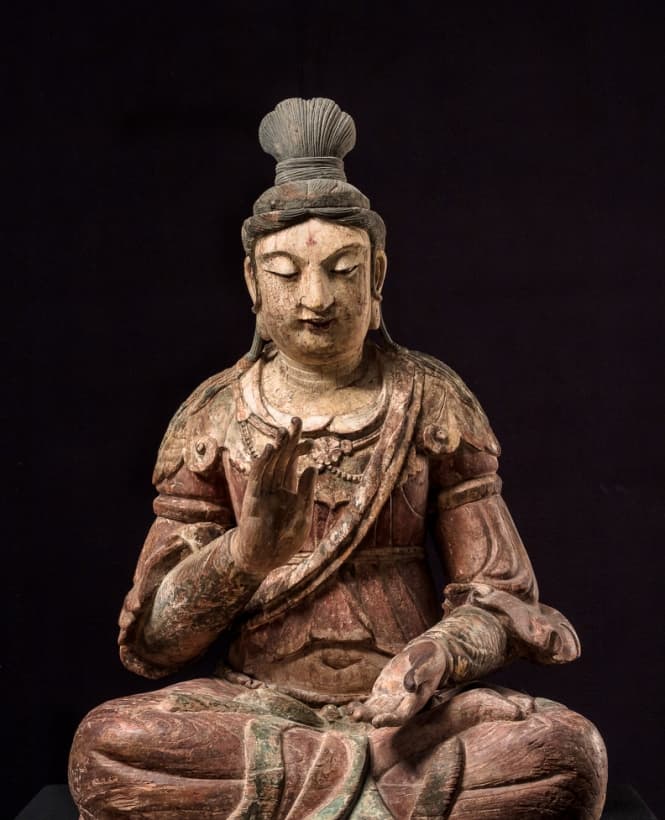
Sitting Bodhisattva
Liao Dynasty
916-1125 C.E.
Painted Wood
110 cm
Wood Sculpture Gallery 102 Perennial Wood Blossoms
The Liao dynasty was founded by the northern nomadic group Qidans, or Khitans, who ruled northeastern China for over 200 years. During the chaotic transition period of the late Tang and the Five Dynasties, the Qidans helped to preserve the Buddhist heritage in a tradition that blends its indigenous free-spirited and robust nomadic style with the Tang-Song traditional characteristics. In this statue, the bodhisattva’s hair is arranged in a tall topknot. His crown is now lost. His round, smooth face with a broad space between the eyebrows is a typical Tang-Song feature. On the other hand, his clothing and appearance display the distinctive Liao style. He is dressed in the current style “hufu,” the fashion of the ethnic minority groups. Two braids fall from behind his ears. A cape drapes around his shoulders. Bejeweled necklaces hang in front of his chest. A long sash crosses from his left shoulder down toward the waist. His upper arms and above the waist are decorated with tied ribbons. The edges of his sleeves flutter as if blown by the wind. His abdomen is slightly exposed above his lower skirt, which displays line patterns of varying density. These stylistic details are unique of Liao Buddhist statues.
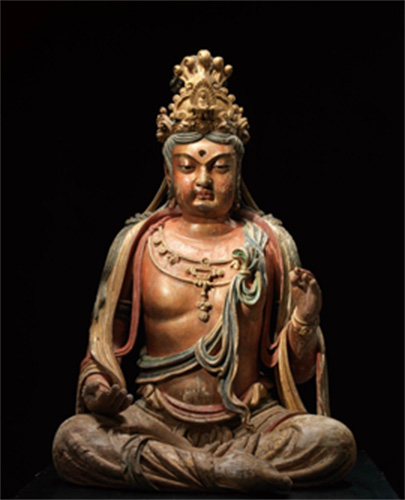
Sitting Avalokiteshvara Bodhisattva
Jin Dynasty
1115-1233 C.E.
Painted Wood
126 cm
Wood Sculpture Gallery 102 Perennial
Wood Blossoms

The Jin dynasty succeeded the Liao to rule northeastern China contemporaneously with the Southern Song dynasty (1127-1279) in the south. During their reigns, the two rivaling dynasties each produced its own distinctive style of statues that enriched Buddhist art. In this statue, the Bodhisattva sits in a lotus posture with his long torso exposed, displaying a strong thick chest and abdomen. His crown, richly adorned with a feather motif and a small buddha icon at the center, is worn around his tall topknot. From behind his neck, two braids fall over his shoulders. He has a plump, squarish face, long eyes with eyebrows slanting upward, and a mustache. The long scarf wrapped around his shoulders drapes straight onto his arms and sides. Another long sash worn over his left shoulder is decoratively knotted with the tail gently falling on the left thigh. The smooth, delicate lines of his lower skirt flow naturally in place. Jin statues expand on the subtle characteristics of the preceding Song-Liao statues to create a style that is both robust and elegant. This Bodhisattva image is an important representative of the Jin statues existing today.
TOP