Millennia in Stone

Millennia in Stone

Buddhist Steles and Rubbings
101D Exhibition Hall

Because of its ability to survive through thousands of years of history, a stone tablet had become an important medium for engraving scriptures and classics, and records of life achievements in ancient China. In India, it was also a tradition to carve the images and names of the donors on the statues they sponsored. After Buddhism came to China from India, as a way to disseminate the teaching, artists combined Buddhist statues and traditional stone tablets to create a new form of sculpture—steles with Buddhist images—which began to appear around the 5th century.

Millennia in Stone features Buddhist steles and rubbing inscriptions.

In between images that reflect how Buddhist teachings and artistic styles evolved and flourished across China, and texts that narrate the life of the great Buddhist masters, these stones of millennia tell the stories of the rise, decline and dissemination of Buddhism through its thousands years' journey.
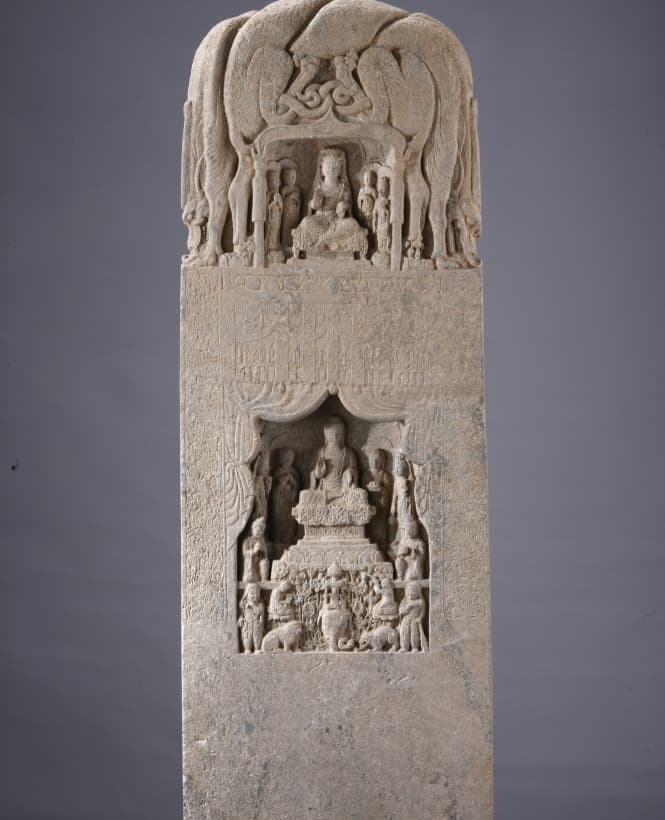
Buddhist Stele, Commissioned by Wang Sini and Others
Western Wei Dynasty
551 C.E.
Schist
192.9 cm
101D Millennia in Stone: Buddhist Steles and Rubbings
This stele magnificently highlights the traditional characteristics of Northern dynasty steles. At the stele's top, two pairs of intertwining dragons canopy the upper niches on the front and back. In the front upper niche, Maitreya Bodhisattva sits with ankles crossed. Inside the main niche sits Shakyamuni Buddha on a raised square pedestal preaching the Dharma, flanked by disciples holding alms bowls and bodhisattvas holding ornaments. Below are two kneeling donors making offerings. Underneath the pedestal is a royal elephant carriage, on which an earth deity is lifting a censer above his head. Lotuses emerge from the elephant's mouth and are blooming around the deity. Flanking the royal carriage are two bhiksus making offerings. Two lions lead the way of the elephant's procession. Standing beside the lions are Dharma guardians with western regions appearance, reflecting the artistic and cultural blending between those regions and Han China.
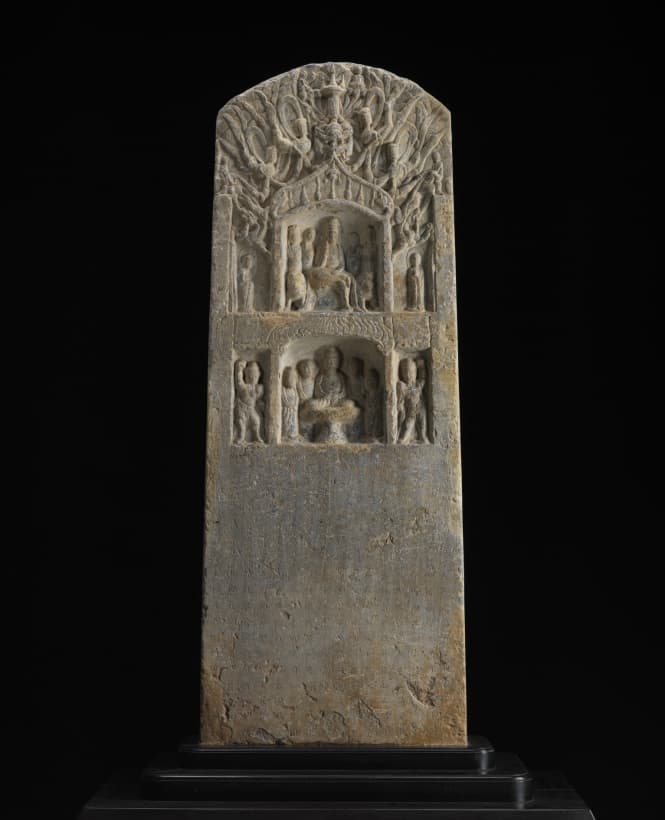
Buddhist Stele, Commissioned by Zhang Wutuo and Others
Tang Dynasty
632 C.E.
Limestone
143 cm
101D Millennia in Stone: Buddhist Steles and Rubbings

This early Tang stele still carries the spirit of the Northern dynasty steles, though lacks their awe-inspiring aura. At the top of the stele are the face of an auspicious beast, a pagoda, celestial beings holding flowing tassels, and flying dragons—images that typically carry cultural and religious meaning. In the upper niche sits a bodhisattva in a contemplative posture; in the main niche is a buddha pentad. Below is an inscription carved in early Tang regular script, which contains the donors' dedications to their deceased ancestors. Robust, precisely executed and elegant, the calligraphy exemplifies the most outstanding works among early Tang stele inscription.
TOP