Ancient Splendor from India
- Home
- Exhibitions
- Permanent Exhibition
- Ancient Splendor from India
Ancient Splendor from India
Indian Buddhist Sculpture
102C Exhibition Hall
Buddhism and Buddhist art originated in India. Indian Buddhist sculpture had begun to evolve before the 1st century CE in the aniconic period, when the Buddha was not depicted in personified images. Through the Gandharan (1st-3rd century), Gupta (4th-6th century) and Pala (8th-12th century) periods, Buddhist sculptures flourished into a variety of styles. They not only shaped the Buddhist images in the coming ages, but also influenced the Buddhist culture in China and all over Asia.
In this gallery, you will see early Gandharan stone carvings and bronzes, and Gupta-Mathura and Swat statues, which explore the characteristics of northwestern Indian Buddhist sculpture.
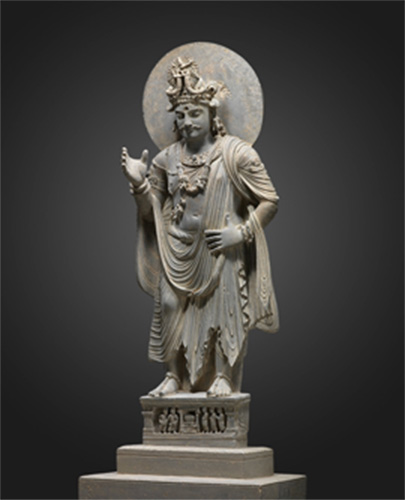
Standing Bodhisattva
Gandhara
3rd-4th Century
Schist
158 cm
102C Ancient Splendor from India: Indian Buddhist Sculpture
3rd-4th Century
Schist
158 cm
102C Ancient Splendor from India: Indian Buddhist Sculpture
Gandhara was an important place of origin for the development of Buddhist art. Gandharan Buddhist carvings are noted not only by characteristics influenced by Hellenistic art, but also by their effects in the development of Buddhist art extending along the Silk Road. The features of this bodhisattva fully reflect the Gandharan style: a graceful face and robust chest resembling the beauty of the Greek god Apollo; richly decorated Brahmin necklace, lion earrings, armlets and bracelets, and cascading braided hair. His crown can be dismantled and reassembled by dovetail joints. Standing on a square pedestal wearing shoes, in an expression of peace and firm resolution, the bodhisattva epitomizes the spirit of the Mahayana ideal to bring benefits to all sentient beings. In its artistic techniques, this piece resembles the Mahaban standing bodhisattva statue at the Guimet Museum in France.


.svg)