The Legacy of Ancient Ji
- Home
- Exhibitions
- Permanent Exhibition
- The Legacy of Ancient Ji
The Legacy of Ancient Ji
Ancient Ji was located in today's Hebei (literally meaning "north of the [Yellow] River"), a province in the northern plain of China. Since the Han dynasty (206 BCE-220 CE), this region had prospered economically and culturally. By the late Eastern Han (25-220), Buddhism had already spread to this region. During the 4th century, famous Buddhist masters such as Dao'an, and Fo Tucheng came to this region to teach the Dharma. As Buddhism became popular in Hebei, so did the making of Buddhist sculpture in this region.
White marble statues began to appear in Hebei in the late Northern Wei (386-534), and flourished during the late Eastern Wei to Sui period (534-618). Most statues were carved from the white marble stone from the Yellow Mountains of Quyang in Hebei.
The Legacy of Ancient Ji explores the development of Hebei white marble statues from the Eastern Wei to Tang-Song period (534-1279)—from the square cheeks, short and stout figure, thin and snug robes of the Eastern Wei (534-550), the round and smooth face, tall and graceful figure, simple and precise pleats of the Northern Qi (550-577), to the new style of the Tang (618-907).
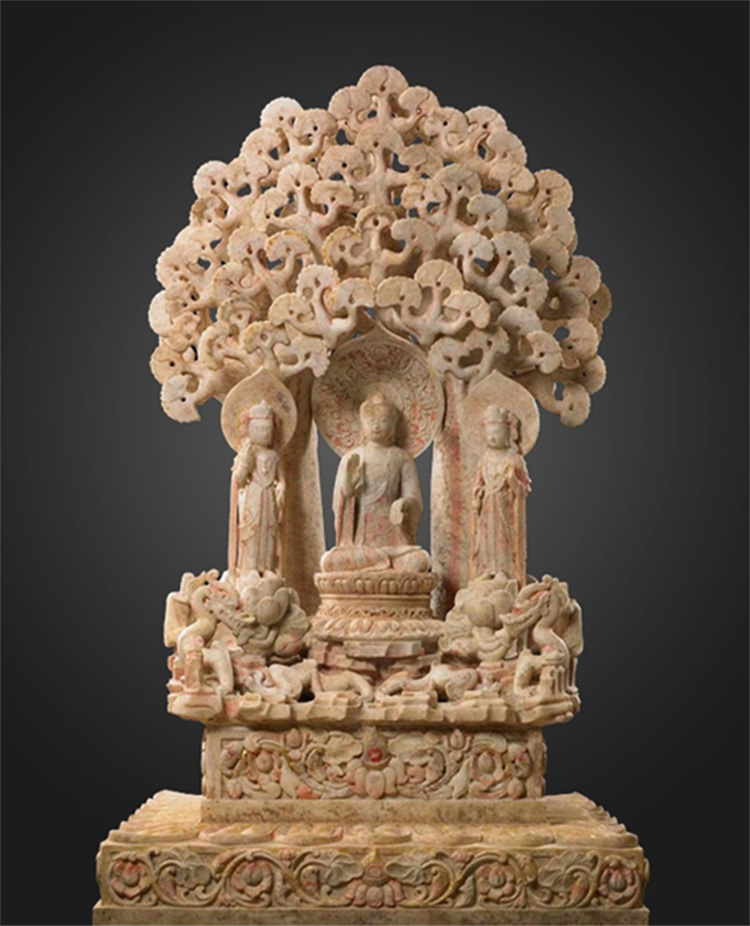
550-577 C.E.
White Marble
145 cm
202C The Legacy of Ancient Ji: White Marble Buddhist Sculpture


.svg)