Transmitting the Dharma

Transmitting the Dharma

Buddhist Sutras
201D Exhibition Hall

Sutra is Sanskrit for scripture, the recorded words of a sage. Buddhist sutras record the Dharma (the Buddha's teaching).

"Wherever a sutra is present, the Buddha is also present." After the Buddha entered nirvana, his disciples assembled to compile a sutra collection in order to pass on the teachings, which Buddhists follow as their guide in the path towards enlightenment.

However, when sutras were first brought to China from India, they were scattered, and during the early translation from Sanskrit to Chinese, their original meaning was often lost. In order to penetrate the Buddha's teaching, Buddhist masters braved all hardships and danger to journey to India in search of more original sutras. Once they returned, they again devoted themselves to translating the texts into Chinese. And once the sutras were translated, they were hand copied or printed for dissemination to future generations.

Seeking the Dharma, translating, copying and printing the sutras—Buddhist disciples dedicated their lives to preserving and protecting the Dharma for only one reason—to enable the original teaching of the Buddha to stay in this world for the enlightenment of all beings.
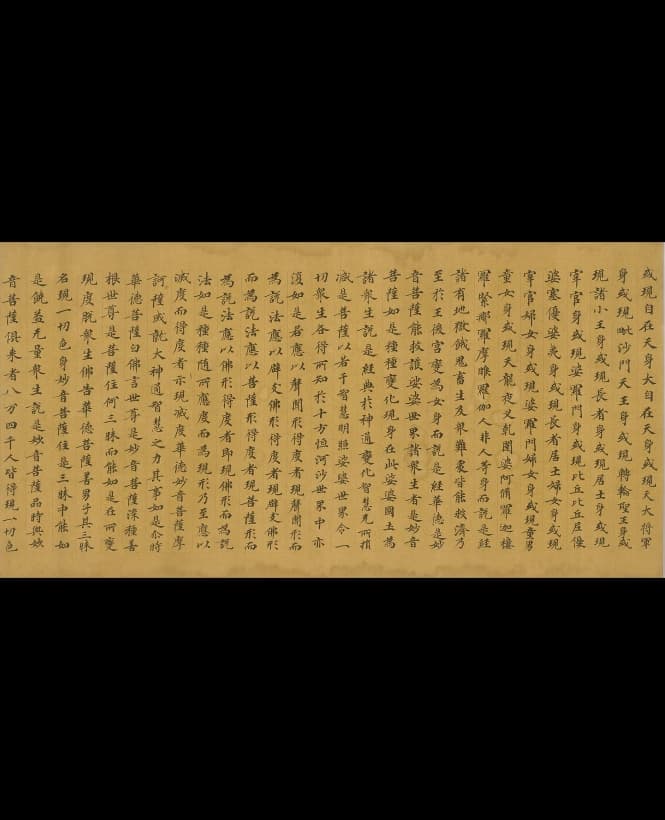
Handwritten Scroll Fragment of the Lotus Sutra
Tang Dynasty
618-907 C.E.
Ink on yellow paper
25 cm
201D Transmitting the Dharma: Buddhist Sutras
This calligraphy contains a segment of the "Wondrous Sound Bodhisattva" chapter of the Lotus Sutra. From the Northern and Southern dynasties to the Sui-Tang period (4th-9th century), sutra copying was mainly done for practical purposes, with neatness and legibility being the main aim. Meanwhile, artistic expression was also beginning to take on importance. This scroll fragment of the Lotus Sutra presents an example of the excellent works in Tang sutra copying calligraphy. The characters are strong and elegant with a gracious shape, revealing a mastery that is beyond the inner discipline and meticulous execution evident in this piece.
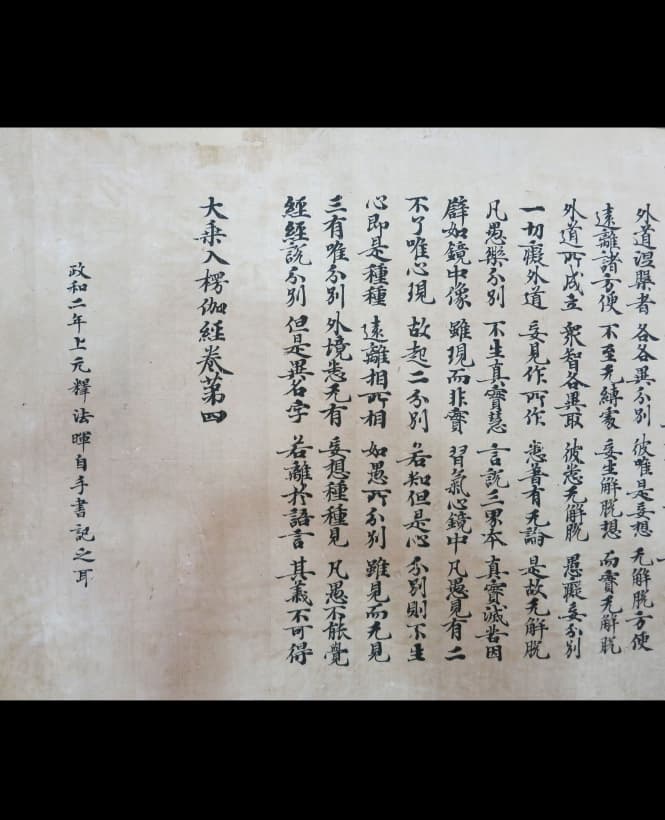
Lankavatara Sutra
Song Dynasty
1112 C.E.
Ink on paper
28.5 cm
201D Transmitting the Dharma: Buddhist Sutras

Sutra copying was always done with sincerity and devotion. Its aim is to bring calm and stillness to the readers' minds, enabling them to connect with the Buddhist teachings. During the period between the Northern dynasties and the Tang (4th-9th century), the style of sutra calligraphy became more broad and diverse as it merged with the current calligraphic features. Since the advancement of woodblock printing in the Song dynasty, sutra copying had become less popular than it was in the Tang period. This sutra scroll, written by Song Dharma master Fa Hui, retains the swift and rich brushworks of the Tang style composition. However, its compact layout and densely set characters also reflect the style of Song calligraphy. The head of the scroll is stamped with the collector's seal, Zhou Tianqiu Gongxia of the Ming dynasty.
TOP