Cast in Brilliance

Cast in Brilliance

Bronze Sculpture
301C、302C Exhibition Hall

Tough and ductile, bronze can be cast into statues with intricate designs and meticulous details. Ancient artisans were able to apply casting, gilding, engraving and other techniques on bronze to create features that are difficult to produce with other materials.

Light and portable, bronze statues were often carried by Buddhist monks on their missionary journey. These delicate artifacts became testimony to the development of Buddhism and the exchange of culture across the Asian continent. Because of their religious and cultural significance, bronze Buddhist statues were enshrined in famous temples and royal houses, and treasured by private collectors.

Through the ages, many bronzes were destroyed, corroded by the elements or recast into weapons during war, making the works that exist today even more rare and precious. The bronze statues spanning the Sixteen Kingdoms to the Ming-Qing dynasties (4th-19th century) featured in this gallery explore the far away origin and long history of development of these precious artifacts.
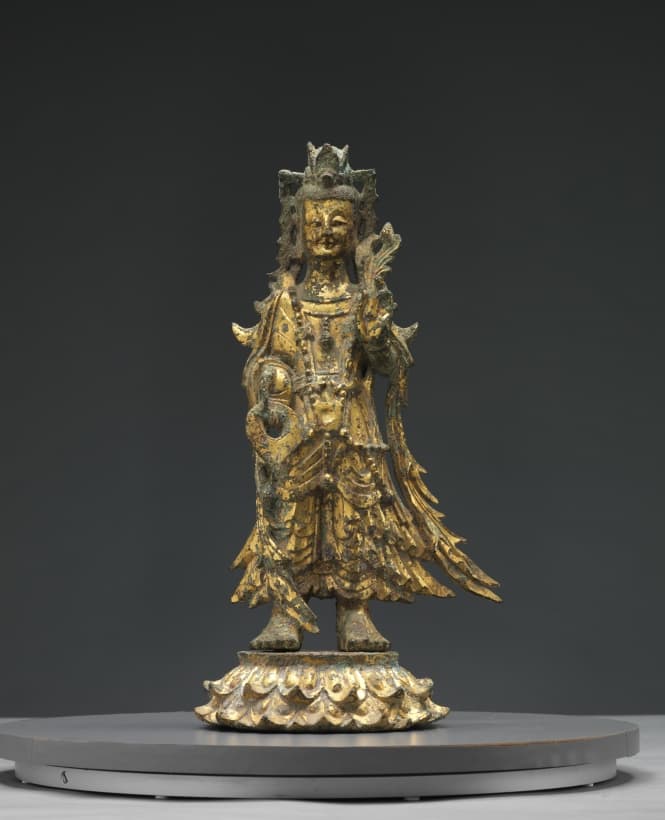
Standing Bodhisattva
Northern Wei Dynasty
386-534 C.E.
Gilt Bronze
45 cm
301C-302C Cast in Brilliance: Bronze Sculpture
The bodhisattva wears a three-leaf crown with ribbons hanging to the shoulders on both sides. He has a square forehead, broad face, and puckered lips revealing a smile. Holding a peach-shaped lock in his right hand, a lotus stem in his left hand, the bodhisattva stands straight on a lotus pedestal. Below his long neck is a choker with a knotted pearl pendant. His thin body is clad with a wide scarf; pearl strands hang down from his narrow shoulders, crossing at a round jade button in front of his abdomen, then veer outwards. The edges of his flowing multilayered, feather-shaped pleated skirt flare out to the sides with a lively air. The beauty of lines and elaborate decoration of this piece is a prominent feature of bronze bodhisattva statues in the late Northern Wei period. The distinctive Han style attire indicates that bronze sculpture of this period had transformed from a foreign style to a Chinese style with indigenous Han characteristics.
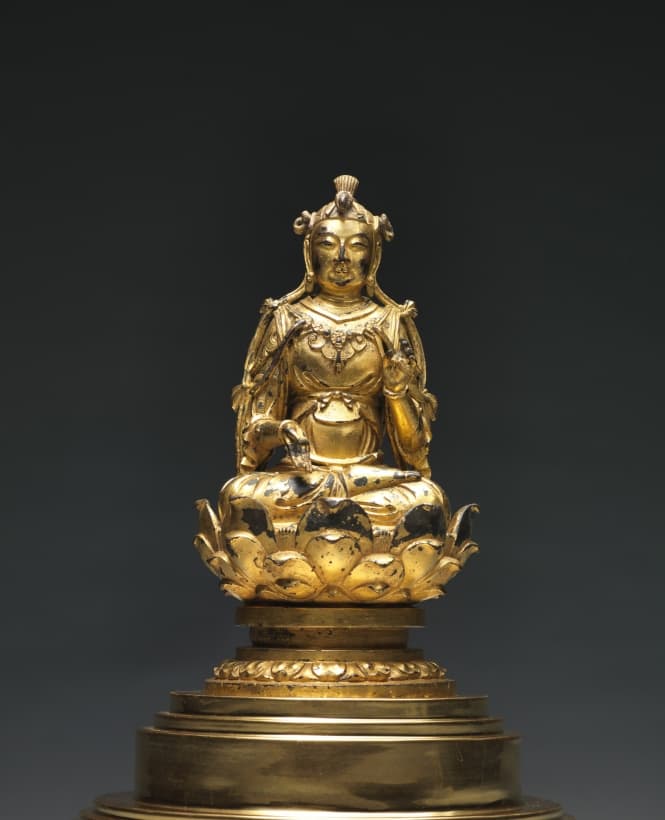
Sitting Manjushri Bodhisattva with Five Knots of Hair
Liao Dynasty
916-1125 C.E.
Gilt Bronze
22 cm
301C-302C Cast in Brilliance: Bronze Sculpture

Inheriting the Tang dynasty tradition, Liao statues reflect the popularity of the Huayan and Esoteric schools. This statue is one example. The bodhisattva's hair is tied into five knots, indicating he is Manjushri Bodhisattva1. He has a plump face, and the appearance of a youth. His full, strong body reflects the Tang style. However, the long upper body, upright posture, cloud pattern on the shoulders, knotted belt tied around the waist, and the distinctively Liao-style snake motif carved on the skirt are features resembling those in the Liao dynasty bodhisattva statues found in the Lower Huayan Temple in Datong, Shanxi province. The two-tiered lotus pedestal has blooming petals; their tips curl outwards, adding liveliness to the piece. 1According to the Esoteric scriptures, Manjushri Bodhisattva in the womb realm (garbhakosa-dhatu) mandala manifests as a youth with five knots of hair, which represents the five buddhas (one in each direction and Mahavairocana Buddha at the center) and buddha's fivefold wisdom. 1According to the Esoteric scriptures, Manjushri Bodhisattva in the womb realm (garbhakosa-dhatu) mandala manifests as a youth with five knots of hair, which represents the five buddhas (one in each direction and Mahavairocana Buddha at the center) and buddha's fivefold wisdom.
TOP