Magnificence Embodied

Magnificence Embodied

Stone Sculpture Through the Ages
103C Exhibition Hall

Since Buddhism spread to China from India during the Han dynasty (1st century), Chinese Buddhist art had evolved through adaptation and innovation. During the 4th to 6th century, the Northern Dynasties (386-581) was ruled by the nomadic Xianbei, Buddhism was revered by emperors and commoners alike, and Daoist and Buddhist teachings mutually influenced each other. Against this social backdrop, Chinese Buddhist sculptures blossomed into a rich variety of styles.

In the early period of the Northern Dynasties, when the capital of Northern Wei (386-534) was in ancient Pingcheng (present day Datong, Shanxi), the style was unembellished and robust with the blending of the nomadic-Hu and Han characteristics. By the mid-late period (after the capital was moved to Luoyang, Henan in 494), the idealized image of the lean and elegant Chinese literati became popular. In the later period of Eastern Wei to Northern Zhou (534-581), classical Indian and innovative Chinese characteristics combined to create an elegant and handsome style.

These different buddha images, smiling upon us compassionately, tell the story of the Buddha’s myriad expedients to lead sentient beings to enlightenment.
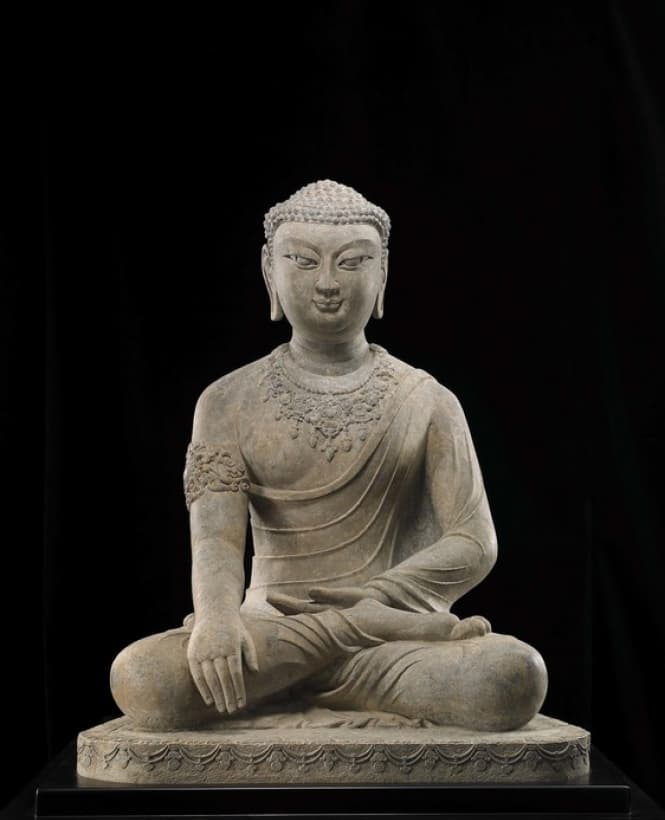
Buddha statue
This seated Buddha statue has a round, full face, with open, gazing directly at the face, exuding a dignified and majestic air. It wears a robe that is slightly open on the right shoulder, and its neck is adorned with a necklace of seven precious jewels. The left hand is in the meditation mudra, while the right arm hangs down, resting on the robe, with a bracelet in the shape of arabesque flowers on the wrist, forming the earth-touching mudra. This image, characterized by its jeweled necklace and earth-touching mudra, is currently considered to be the ancient Indian depiction of Shakyamuni's enlightenment. According to the *Great Tang Records on the Western Regions*, this type of image originally existed in Magadha, ancient India, and was said to be a portrait of Shakyamuni Buddha sculpted by Maitreya Bodhisattva himself, representing a style prevalent in early Tang Dynasty Bodhi auspicious images.
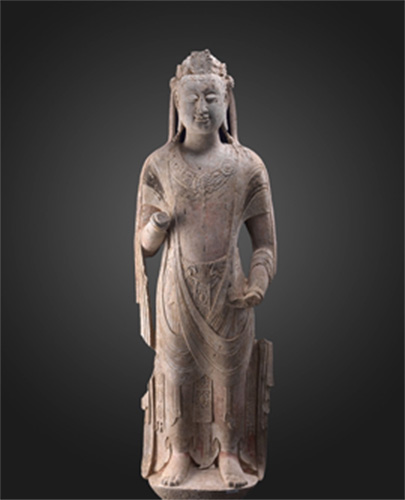
Standing Bodhisattva
Northern Qi Dynasty
550-577 C.E.
White Marble
212 cm
103C Magnificence Embodied: Stone Sculpture Through the Ages

This statue presents an excellent example of the large freestanding carvings of Northern Qi. Its well-proportioned structure, and meticulously carved jewelry and ornaments highlight the superb artistry and simple elegance typical of the Northern Qi style. The bodhisattva is wearing a ruyi (scepter)-shaped crown decorated with gems and shield-shaped ornaments. Knotted ribbons with flower vine motifs and braided hair hang down to the shoulders from the side of the crown. A necklace of precious stones tied from the back adorns the neck; the gems are densely set in delicate patterns. The top of the lower skirt is folded over around the waist, with two knotted belts falling straight down along the legs. Three wide belts decorated with precious gems symmetrically hang down the front of the skirt. The patterns on the garment are carved in thin lines, densely laid out but not crowded or busy. Barefoot, the bodhisattva stands on a lotus stand. His hands are both damaged. Some of the original colors painted on his body are still discernible.
TOP