Commemorative Inscription
Commemorative Inscription
Life Journey of the Ancients
102D Exhibition Hall
In China, a stone tablet with an epitaph inscription (known as a muzhi) is mainly placed inside a tomb. A cover inscribed with a title identifying the tomb occupant is often placed over the tablet. The epitaph is divided into two parts: a prose biographical account of the deceased's name, family background, life events, date of death and place of burial, and a rhymed laudatory verse commemorating the deceased.
The life stories of the deceased often reflect the views on life and death and the funerary culture of the time. They may provide useful, even precious, information on family history, regional chronicles, or the history of the period.
The epitaphs on display in this gallery give us not only a glimpse into the life journey of the ancients, but also an opportunity to reflect on our own understanding of life.
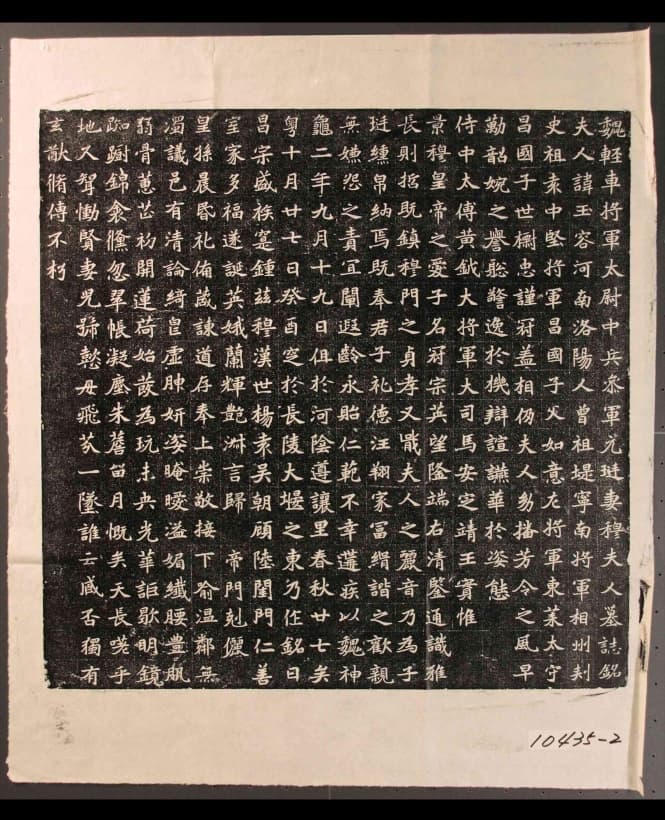
Epitaph of Mu Yurong, Yuan Ting's wife
Northern Wei Dynasty
519 C.E.
Stone Rubbing on Paper
40 cm
102D Commemorative Inscription: Life Journey of the Ancients
Mu Yurong was born into an imperially honored noble family of the Xianbei race, which was the northern minority group that ruled the Northern Wei dynasty. Mu's husband was a military grand commandant, who was also of royal descent. Now in the Xi'an Beilin Museum, this epitaph was unearthed near Nanchen village in Luoyang, Henan province in 1922. It originally belonged to a private collection in a set of "Seven Epitaphs of Yuan Yang," which are epitaphs of husband and wife. Northern Wei calligraphy, also known as Wei Bei script, continues the early form of regular script developed since the end of Han dynasty (3rd century), but adds a slanting shape and angular turning strokes to the characters to create a strong and classical style. This epitaph inscription adds to the basic Wei Bei style a square structure, yet still presents variety in the brushworks. It marks the stylistic transition of Wei bei from the strong and free-spirited brushworks of its early period to a gentle and elegant formative style.



.svg)